
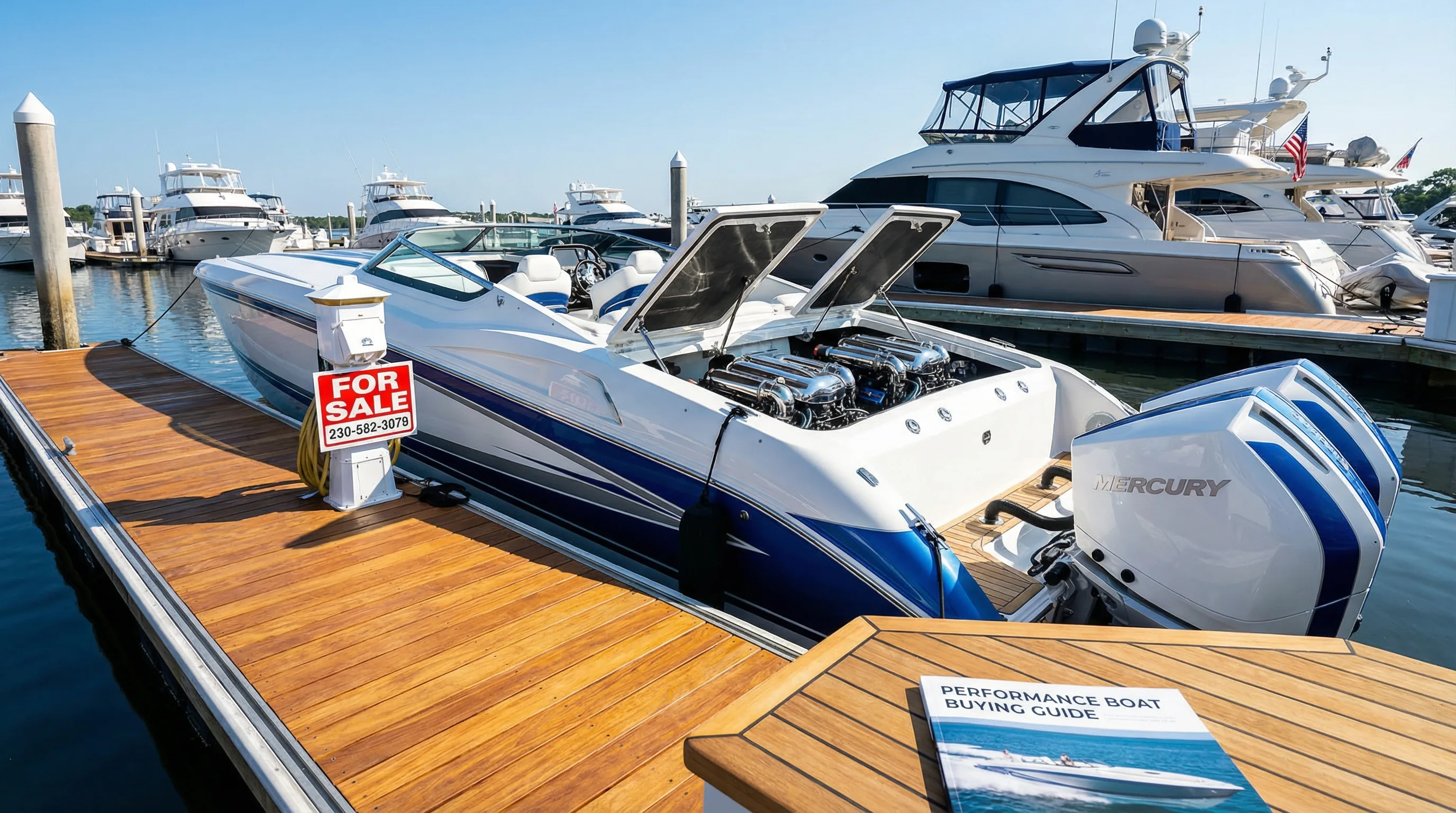
Introduction
Performance boats are a different breed. The speed, the sound, the rush of acceleration — there is nothing else like it on the water. But buying a performance boat is also a significant investment, and the wrong purchase can turn a dream into an expensive headache.
Whether you are stepping up from a standard runabout or adding another go-fast machine to your fleet, this guide covers everything you need to know before pulling the trigger. At Trammel Marine Brokerage, performance boats are our specialty, and we have seen every scenario — the great deals and the money pits.
Understanding Performance Boat Types
Not all performance boats are the same. Before you start shopping, understand the main categories and where they excel.
Center Console Performance Boats
Brands like Fountain, Donzi, and Yellowfin build center consoles designed for speed and offshore capability. These boats typically feature:
- Deep-V hulls for rough water handling
- Twin or triple outboard power
- Top speeds of 60-90+ MPH
- Fishing and cruising versatility
They are ideal for boaters who want speed but also want to fish, island-hop, or cover distance offshore.
V-Bottom Go-Fast Boats
This is the classic performance boat category — sleek, low-profile hulls built purely for speed. Brands like Fountain Lightning, Donzi ZR series, and Sunsation dominate this space.
- Stepped or non-stepped V-bottom hulls
- Inboard or sterndrive power (Mercury Racing, Ilmor)
- Top speeds of 80-140+ MPH
- Built for lake running, poker runs, and open water speed
These boats demand respect. They are fast, loud, and exhilarating.
Catamaran Performance Boats
High-performance catamarans from builders like Eliminator, Skater, and DCB offer extreme speed with remarkable stability. Key features:
- Twin-hull design for stability at high speed
- Typically the fastest boats on the water (100-180+ MPH)
- Inboard power with Mercury Racing or Ilmor engines
- Popular in the poker run and race boat community
Deck Boats and Sport Boats
For boaters who want performance with more versatility, brands like Crownline, Cobalt, and Formula offer sport boats that combine speed with family-friendly features.
- 45-65 MPH top speeds
- Comfortable seating for 8-12 passengers
- Sterndrive or outboard power
- Great for day cruising, watersports, and entertaining
What to Look for When Buying Used
The majority of performance boat transactions involve pre-owned vessels. Here is what to evaluate.
Engine Hours and History
Engine hours are the most critical data point on any performance boat. Low hours sound great, but context matters.
- Under 200 hours on a 10+ year old boat can actually be a concern — boats that sit unused deteriorate
- 500-800 hours on well-maintained engines is perfectly normal
- 1,000+ hours is not a deal-breaker if maintenance records are solid, especially on outboards
- Ask for maintenance records — oil changes, impeller replacements, winterization history
The condition of the engines matters more than the raw hour count.
Hull Condition
Inspect the hull carefully, both above and below the waterline.
- Gelcoat — Look for cracks, spider cracks, blistering, and previous repair work
- Stringers and transom — Tap-test for soft spots that indicate water intrusion and rot
- Bottom paint — Heavy buildup or multiple layers can add weight and hide problems
- Running surface — Check for gouges, prop damage, or impact marks
On performance boats, hull integrity is non-negotiable. A compromised hull at high speeds is a safety risk.
Drives and Running Gear
For sterndrive boats, inspect:
- Outdrive condition — Look for corrosion, trim cylinder condition, and bellows integrity
- Propellers — Check for dings, bends, and hub wear
- Steering system — Should be responsive with no play or stiffness
- Trim tabs — Functional tabs make a big difference in ride quality
For outboard boats:
- Lower unit — Check for leaks, corrosion, and water in the gear oil
- Tilt and trim — Should operate smoothly through full range
- Cowling condition — Cracks or missing hardware suggest rough use
Electrical and Electronics
Performance boats have complex electrical systems. Verify:
- All gauges work — speedometer, tachometer, fuel, oil pressure, temperature
- Bilge pumps operate correctly
- Navigation lights function
- Horn and any sound systems work
- GPS, depth finder, and other electronics power on and function
Trailer
If the boat comes with a trailer, inspect it separately.
- Tires and bearings — Check for dry rot, tread wear, and bearing condition
- Axles and brakes — Ensure disc or drum brakes function properly
- Bunks or rollers — Should support the hull properly
- Frame — Look for rust, cracks, or bends
- Lights — All trailer lights must work for legal road use
The Marine Survey
Always — and we mean always — get a professional marine survey before buying a performance boat. A qualified surveyor will:
- Inspect the hull, structure, and systems
- Moisture-test the hull and deck
- Evaluate engine compression and performance
- Identify hidden problems you cannot see with a visual inspection
- Provide an estimated market value
The survey typically costs $15-$30 per foot and can save you thousands by uncovering problems before you commit.
At Trammel Marine Brokerage, we coordinate surveys and sea trials for every buyer we represent. It is a non-negotiable part of our process.
Sea Trial Essentials
A sea trial is your opportunity to evaluate the boat’s performance on the water. Here is what to pay attention to:
- Cold start — Does the engine fire up easily? Any smoke, knocking, or hesitation?
- Idle behavior — Smooth idle at proper RPM? Any vibration?
- Acceleration — Should be smooth and progressive. Note any bogging, misfire, or unusual sounds.
- Top speed — Verify it meets expectations for the engine configuration.
- Handling — How does it turn, trim, and track? Any pulling to one side?
- Gauges — Monitor oil pressure, temperature, and voltage at all RPM ranges.
- Wake and ride quality — How does it handle its own wake and chop?
Take your time. A 30-minute sea trial can tell you more than a week of research.
Common Pricing Factors
Performance boat values depend on several variables:
- Brand and model — Some brands hold value better than others
- Engine type and hours — Mercury Racing and Ilmor engines command premiums
- Freshwater vs. saltwater use — Freshwater boats typically bring higher prices
- Condition and maintenance — A well-maintained boat with records is worth significantly more
- Upgrades — Custom paint, rigging, electronics, and audio systems add value
- Market timing — Spring and early summer typically see the highest prices
Ready to Find Your Performance Boat?
Looking for the right performance boat? Contact Trammel Marine Brokerage today. We specialize in connecting serious buyers with quality performance, luxury, and sport boats. Call us at (513) 515-4556 or browse our current inventory.