
Introduction
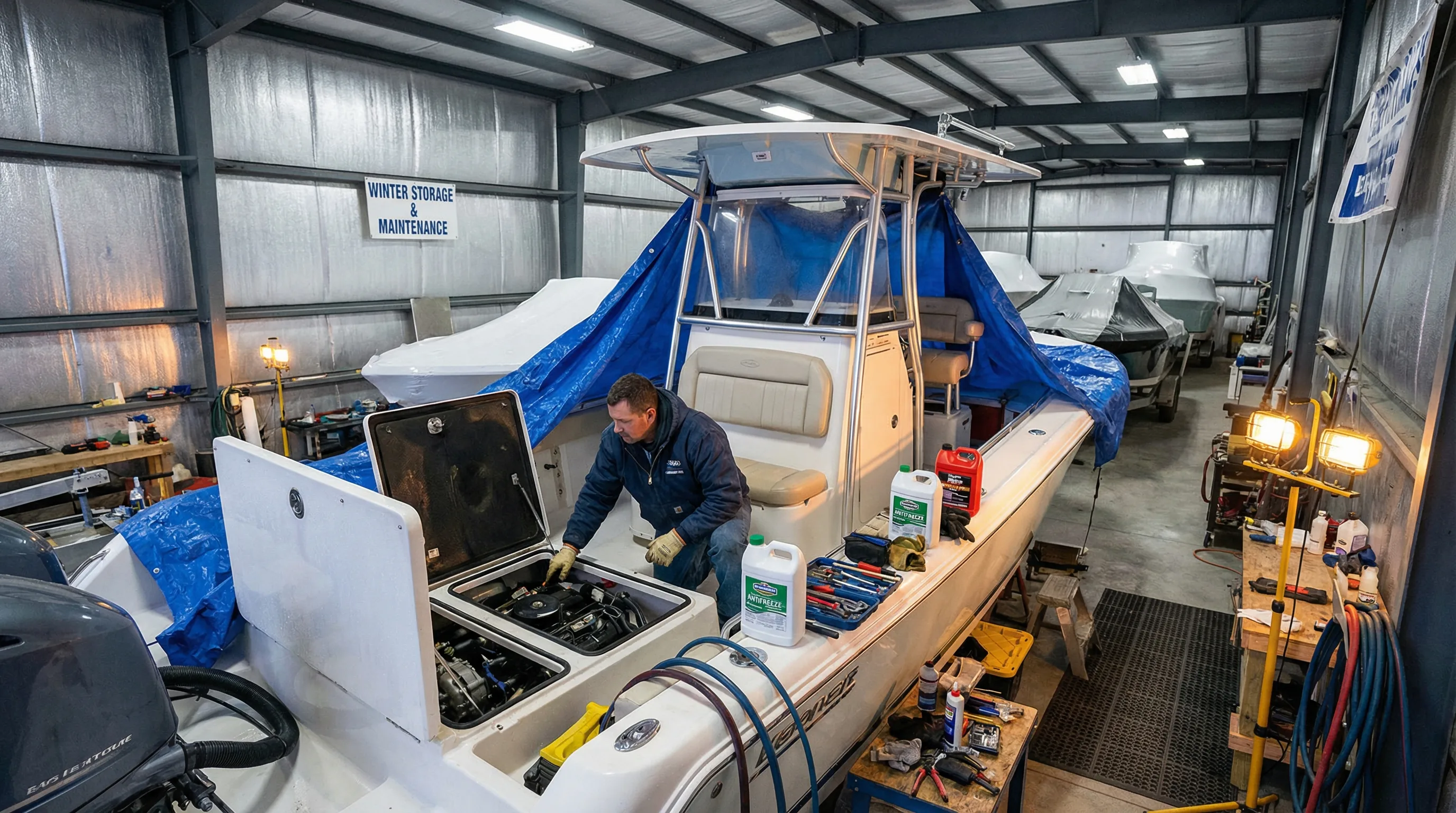
For boaters in Cincinnati, the Ohio Valley, and across the Midwest, winterizing your boat is not optional — it is essential. Freezing temperatures can destroy engines, crack blocks, split hoses, and cause thousands of dollars in damage to systems that are straightforward to protect with proper preparation.
Whether you handle winterization yourself or hire a professional, understanding what needs to happen and why it matters will help you protect your investment and ensure a smooth startup when spring returns.
At Trammel Marine Brokerage, we see the consequences of poor winterization every selling season. Cracked blocks, corroded fuel systems, and mildew-damaged interiors are common — and they all crush resale value. This guide covers everything you need to do to avoid those problems.
When to Winterize
In the Cincinnati and Greater Ohio area, most boaters pull their boats out between late October and mid-November. The general rule: winterize before sustained temperatures drop below 40 degrees Fahrenheit.
Do not wait for the first hard freeze. By then, the damage may already be done if water remains in your engine, cooling system, or plumbing.
Engine Winterization
The engine is the most critical system to protect. The process differs depending on your power configuration.
Inboard and Sterndrive Engines
- Run the engine to operating temperature — This ensures contaminants are suspended in the oil for removal.
- Change the oil and filter — Dirty oil contains acids and moisture that corrode internal components over winter.
- Fog the engine — Spray fogging oil into the carburetor or throttle body while the engine is running to coat internal surfaces with a protective film.
- Drain the cooling system — Open all drain plugs and petcocks. For raw-water-cooled engines, ensure every passage is drained. For closed-cooling systems, check antifreeze concentration.
- Run antifreeze through the raw water system — Use non-toxic propylene glycol antifreeze rated to at least -50 degrees Fahrenheit.
- Drain the outdrive or sterndrive — Remove the drain plug from the lower unit. Refill with fresh gear lube and check for milky fluid, which indicates water intrusion.
- Grease all fittings — Gimbal bearing, U-joints, and steering components.
- Remove or disconnect the battery — Store batteries in a warm, dry location and keep them on a trickle charger.
Outboard Engines
- Flush the engine with fresh water — Use muffs or a flush adapter. Run until the engine reaches operating temperature.
- Change the oil — On four-stroke outboards, change the engine oil and filter.
- Fog the cylinders — Remove spark plugs or use the fogging procedure recommended by the manufacturer.
- Drain and refill the lower unit gear oil — Inspect the old oil for water contamination (milky appearance).
- Stabilize the fuel — Add fuel stabilizer to a full tank and run the engine long enough for treated fuel to reach the carburetors or injectors.
- Spray corrosion inhibitor — Coat the powerhead and electrical connections with a corrosion-resistant spray.
- Trim the engine to the down position — This prevents water from pooling in the exhaust system.
Fuel System
Fuel is one of the most commonly neglected winterization items, and ethanol-blended fuels make it worse.
- Fill the tank to 90-95% capacity — This minimizes condensation inside the tank. Leave a small air space for expansion.
- Add marine-grade fuel stabilizer — Follow the manufacturer’s recommended ratio. Run the engine after adding stabilizer to distribute it through the entire fuel system.
- Inspect fuel lines and connections — Look for cracking, swelling, or leaks. Replace anything questionable.
- Consider a fuel water separator filter change — Start spring with a clean filter.
Ethanol in fuel absorbs moisture over time, which leads to phase separation — a destructive condition where the ethanol and water separate from the gasoline and settle to the bottom of the tank. Fuel stabilizer helps prevent this.
Freshwater and Plumbing Systems
Any boat with a freshwater system, head, or livewell needs to have all water removed and antifreeze run through the lines.
- Drain all freshwater tanks — Open all faucets and let them run until empty.
- Drain the water heater — If equipped.
- Pump non-toxic antifreeze through all lines — Use the winterize valve if your boat has one, or disconnect the intake and pump antifreeze from a bucket through the system.
- Pump antifreeze through the head — Both intake and discharge sides.
- Drain livewells, washdown systems, and bilge pump lines — Any line that holds water must be drained or protected.
Interior Protection
Your boat’s interior takes a beating during winter storage if not protected.
Prevent Mildew and Moisture
- Remove all fabric items — Cushions, life jackets, towels, and anything that holds moisture.
- Open all compartments and storage areas — Allow air circulation to prevent mildew.
- Place moisture absorbers — DampRid or similar products in the cabin, console, and storage areas.
- Leave the bilge plug out — This allows any accumulated water to drain rather than freeze.
Protect Surfaces
- Apply UV protectant to vinyl surfaces — This prevents cracking and fading.
- Clean and condition any leather — If applicable.
- Wipe down the dashboard and electronics — Dust and moisture are enemies of electronic components.
Covering and Storage
How you store your boat matters as much as the mechanical winterization.
Shrink Wrap vs. Canvas Cover
- Shrink wrap provides the best protection — fully sealed against rain, snow, ice, and wind. Most marinas offer shrink-wrapping services.
- A fitted canvas cover works well if it is in good condition and properly supported. Use a frame or support poles to prevent water pooling.
- A tarp is the last resort — Tarps flap in the wind, allow moisture in, and can damage gelcoat. If you must use one, secure it extremely well.
Indoor vs. Outdoor Storage
- Indoor storage is ideal — climate-controlled is the gold standard, but even an unheated barn or building provides protection from the elements.
- Outdoor storage is common and works fine if the boat is properly covered and supported on a quality trailer or stands.
Trailer Care
If your boat sits on a trailer over winter:
- Check tire pressure — Inflate to the recommended PSI. Consider placing plywood under the tires to prevent flat spots.
- Inspect the trailer frame — Touch up any rust spots with paint to prevent further corrosion.
- Grease wheel bearings — Or at minimum, inspect them for wear.
- Check the coupler and safety chains — Make sure they will be road-ready in spring.
Spring Recommissioning Preview
When spring arrives, your decommissioning checklist becomes your recommissioning checklist in reverse:
- Charge and reinstall batteries
- Inspect belts, hoses, and connections
- Change the fuel water separator filter
- Check all fluid levels
- Lower unit gear oil check
- Run engine with muffs before launch
- Test all electronics, gauges, and bilge pumps
- Inspect the hull and bottom paint
- Reinstall the drain plug (do not forget this one)
- Launch and sea trial
Protect Your Investment
A properly winterized boat retains its value, starts reliably in spring, and avoids the costly repairs that come from neglect. If you are not comfortable doing the work yourself, most marine service centers and marinas in the Cincinnati area offer full winterization packages.
Thinking about selling your boat this spring? A boat that has been properly winterized and maintained is worth significantly more than one that has not. Contact Trammel Marine Brokerage to discuss listing your boat. Call us at (513) 515-4556 — we are happy to help you plan ahead.